// ARCHIVE :: PRIMARY_RECORD

Two clinical archives, one regulatory archive, read together.

The published research on sermorelin is largely a record from the 1990s, augmented by a 2024 review from the lab that originated GHRH peptide chemistry. The regulatory record is a thirty-five-year arc from first NDA to current 503A status.

// SHORT_VERSION :: THE_RESEARCH_RECORD

The published clinical record on sermorelin is small and mostly old: pharmacokinetic work from 1993 establishing the eleven-minute half-life and the three-hour GH pulse it triggers, pediatric efficacy data underpinning the 1997 FDA approval, a handful of aging-axis studies from the late 1990s showing GH and IGF-1 can be restored toward younger-adult levels in healthy older men, and a 2025 authoritative review synthesizing three decades of GHRH-analog pharmacology. The regulatory archive runs alongside: two NDAs, a 2008 commercial withdrawal, a 2013 Federal Register non-safety determination, and the current 503A compounding pathway. Neither archive settles what sermorelin does for adult wellness in 2026 — the aging studies are small and unreplicated, and the compelling cognition signal from a 20-week trial used a different, longer-acting molecule. This page reads the two archives together.

Mechanism: a 29-amino-acid peptide acting one synapse upstream of growth hormone

Sermorelin is GHRH(1-29)-NH2: a synthetic, amidated 29-residue peptide whose sequence reproduces the amino-terminal fragment of endogenous human growth hormone-releasing hormone [1]. The native hypothalamic peptide is 44 amino acids long; the (1-29) fragment retains essentially full receptor binding and growth-hormone-releasing potency [1][12]. The molecular formula is C149H246N44O42S; the molecular weight is 3357.93 daltons; the CAS number is 86168-78-7 (acetate salt 114466-38-5) [6].

The receptor is the GHRH receptor (GHRHR), a Class B G-protein-coupled receptor expressed on anterior pituitary somatotrophs [7][10]. Binding activates a Gs-coupled adenylyl cyclase / cAMP / PKA cascade, leading to pulsatile release of endogenous growth hormone and subsequent hepatic IGF-1 production [7]. The somatostatin negative-feedback loop is preserved because the pituitary remains the effector — a structural difference from exogenous recombinant human growth hormone that has shaped the clinical literature on sermorelin specifically and on GHRH analogs generally [7][12].

GHRH receptor expression has also been documented in extra-pituitary tissues, including heart, pancreas, and immune cells [10]. That receptor distribution does not extend sermorelin's approved indications, but it is the reason a generation of GHRH-receptor agonists developed after sermorelin — the MR-series compounds from the Schally lab — have been studied in animal models for cardiac repair, neuroprotection, and metabolic disease [8][9].

The clinical archive: 1993 to 1999

The pharmacokinetic anchor is the Wilton et al. (1993) study in Acta Paediatrica Supplement, which administered GHRH(1-29)-NH2 intravenously and intranasally to healthy adult volunteers [1]. Intravenous doses of 0.25 micrograms per kilogram elicited significant GH release, with maximal response at 1–2 micrograms per kilogram and serum GH elevation lasting roughly three hours despite sermorelin's own rapid elimination [1]. Intranasal bioavailability was only 3–5 percent, foreclosing intranasal use as a clinically practical route [1].

The pivotal pediatric record is summarized in the Prakash and Goa (1999) review in BioDrugs, which describes once-daily subcutaneous sermorelin 30 micrograms per kilogram at bedtime producing sustained height-velocity increases over twelve months in prepubertal children with idiopathic growth hormone deficiency, with preliminary data suggesting efficacy maintained out to thirty-six months [2]. The same review describes a 1 microgram per kilogram intravenous dose serving as a rapid and relatively specific provocative test for diagnosing pediatric GH deficiency, with fewer false positives in non-deficient children than competing provocative agents — the basis for the 1990 diagnostic indication [3][11].

The adult aging-axis literature is small and old. Khorram, Laughlin and Yen (1997) ran a 16-week single-blind randomized placebo-controlled study of nightly subcutaneous GHRH(1-29) 10 micrograms per kilogram in nineteen healthy adults aged 55–71 [4]. The study reported significant increases in nocturnal GH and IGF-1, a mean 1.26 kg gain in lean body mass in men, and statistically significant skin-thickness increases (a dermal-collagen marker) in both sexes [4]. A parallel report by Vittone et al. (1997) in Metabolism documented body-composition shifts and reduced abdominal adiposity in healthy elderly men receiving nightly subcutaneous GHRH(1-29) over three months [5]. Both studies are small, both predate modern reporting standards, and neither has been replicated in an adequately powered contemporary trial.

The pharmacokinetic record

The FDA-archived prescribing information for the original sermorelin product provides the cleanest pharmacokinetic numbers [6]. After a 2 mg subcutaneous dose in healthy adults, mean absolute bioavailability was approximately 6 percent, peak plasma concentrations occurred within 5–20 minutes, plasma clearance was 2.4–2.8 L/min, and the terminal half-life was 11–12 minutes after either intravenous or subcutaneous administration [6].

That eleven-minute half-life is the point. Sermorelin is degraded rapidly by dipeptidyl peptidase-IV (DPP-IV) in plasma — fast enough that the resulting GH pulse, which persists for roughly three hours, is the product of one pituitary release event rather than a sustained elevation of circulating sermorelin [1][6]. The DPP-IV vulnerability is also the reason later analog development focused on protease-resistant modifications: tesamorelin, the only currently FDA-approved GHRH analog, is a stabilized GHRH(1-44) carrying a trans-3-hexenoic acid modification at the N-terminus that confers DPP-IV resistance and a longer effective half-life [18][19].

The regulatory archive: 1990, 1997, 2008, 2013, 2024

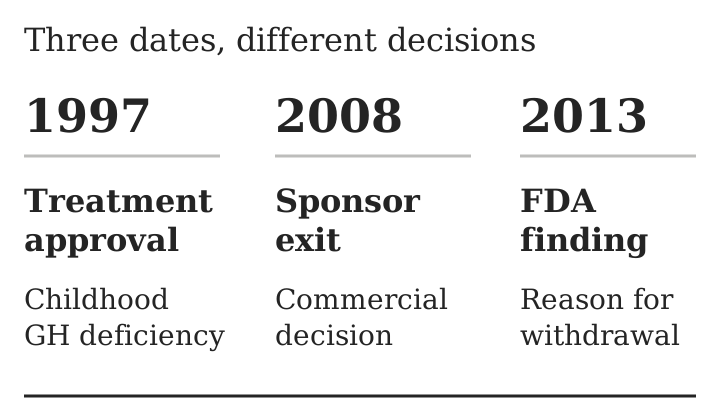
The FDA approval record for sermorelin spans two NDAs. The first, in 1990, cleared sermorelin acetate as a diagnostic provocative agent for pituitary growth-hormone evaluation. The second, in 1997, cleared a once-daily subcutaneous formulation for the treatment of idiopathic growth hormone deficiency in prepubertal children, at a labeled dose of 30 micrograms per kilogram at bedtime [6][13].

The sponsor voluntarily discontinued both NDAs in 2008. FDA withdrew marketing approval administratively effective June 18, 2009. In March 2013, the agency published a Federal Register notice — formal citation 78 FR 14296 — formally determining that the previously approved sermorelin acetate Injection 0.5 mg and 1.0 mg vials and 0.05 mg ampules 'were not withdrawn from sale for reasons of safety or effectiveness' [13]. That determination is the procedural keystone of sermorelin's current legal posture: it preserves the pathway for any future ANDA filing on those strengths and it informs FDA's treatment of the substance under the 503A compounding framework [13][14].

The operative 503A architecture is defined in the FDA's Interim Policy on Compounding Using Bulk Drug Substances Under Section 503A, most recently revised in 2024 [14]. The interim policy sorts nominated bulk substances into Category 1 (eligible pending final rulemaking; FDA exercises enforcement discretion), Category 2 (significant safety concerns; not permitted), and Category 3 (insufficient information) [14]. The Pharmacy Compounding Advisory Committee (PCAC) is the FDA advisory body whose recommendations inform whether a nominated substance receives permanent permitted status [14]. Sermorelin has been treated as eligible for 503A compounding under this framework, but the eligibility is regulatorily contingent rather than statutorily settled — a September 2024 FDA action removed five other peptides (AOD-9604, CJC-1295, ipamorelin, thymosin alpha-1, Selank) from Category 2 pending PCAC review, illustrating the active regulatory churn in this zone [20].

The contemporary scientific record is anchored by Schally et al. (2024) in Reviews in Endocrine and Metabolic Disorders — a comprehensive review from the lab of the Nobel laureate Andrew Schally, who originated much of the GHRH peptide chemistry [8]. The review positions sermorelin as the foundational first-generation clinical GHRH(1-29) agonist and surveys subsequent agonist and antagonist generations developed for oncology, cardiac repair, neuroprotection, and metabolic disease [8][9].

How to read the record together

The clinical archive and the regulatory archive answer different questions. The clinical archive documents that sermorelin reliably triggers a GH pulse in humans, that the pulse is dose-dependent, that the half-life is short enough to preserve pulsatility, and that pediatric efficacy in idiopathic GH deficiency was sufficient to support a 1997 FDA approval. The regulatory archive documents that the sponsor exited the market in 2008 for commercial rather than safety reasons, that FDA formalized that distinction in 2013, that the substance currently moves through the 503A compounding channel rather than as an approved finished product, that the DEA does not schedule it, and that the WADA Prohibited List enumerates it.

Neither archive answers the question of what sermorelin is for, in 2026, outside the original pediatric indication. The 1990s adult aging-axis studies are small. The contemporary review literature is largely mechanistic rather than clinical [8][9]. That gap is itself part of the regulatory picture: a substance with an old, narrow clinical evidence base, an interim compounding pathway, and an active sport-doping prohibition will continue to be read as a regulatorily contingent compound, not a settled therapeutic.